Where should this crop go?
Suitability mapping for current conditions and future climate scenarios, species distribution models (MaxEnt, random forest, BRT, GAM), and subnational targeting for expansion into new growing regions.
Spatial data science for climate-resilient agriculture
I work with satellite imagery, climate records, and machine learning, and I translate that data into practical maps and spatial models for research institutes, development agencies, and agribusinesses. I have been at this for twelve years, across Latin America, Africa, and Australia, and most of the methods behind it have been through peer review.
Based in Morocco. Open to remote and international projects. PhD candidate, University of Twente (ITC).
These questions represent the core of my spatial data workflows. I provide complete technical transparency, delivering reproducible code and workflows that your internal team can easily verify and build upon.
Suitability mapping for current conditions and future climate scenarios, species distribution models (MaxEnt, random forest, BRT, GAM), and subnational targeting for expansion into new growing regions.
Watershed delineation, water yield and ecosystem-service modelling (InVEST), drought monitoring, and rainfall-runoff analysis. My graduate training is in hydrometeorology, so this is home ground.
Climate sensitivity and vulnerability assessments, adaptation prioritisation, and risk indices for agricultural and ecological systems, resolved down to district level.
Everything runs in R, Python, Google Earth Engine, and Quarto, so you can open it up and see exactly how it works. When new datasets are available, your team can execute the entire pipeline independently.
One for each of the questions above. Each started as messy field data and ended up peer-reviewed and published.
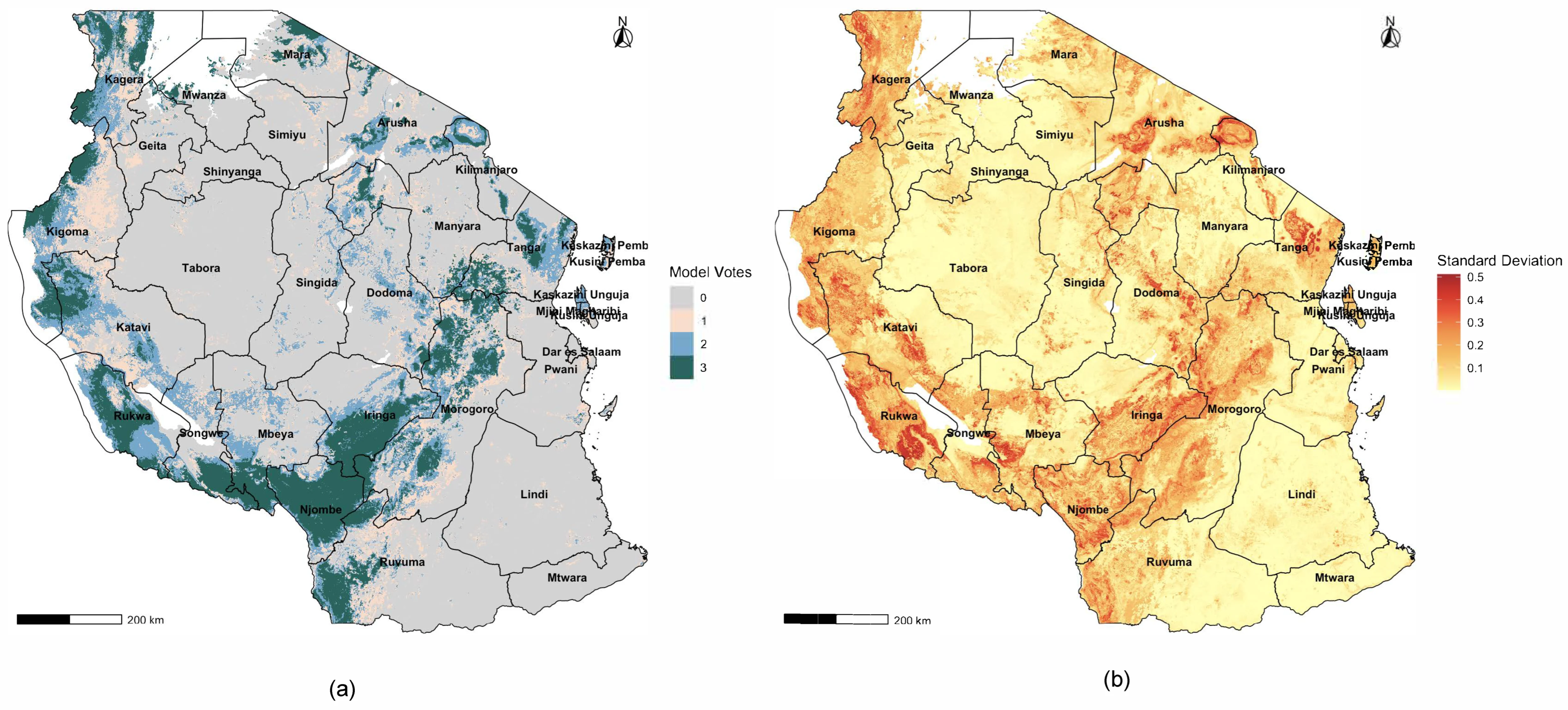
Fig. Inter-model agreement (a) and uncertainty (b), avocado suitability, Tanzania
Tanzania's avocado exports are growing fast, but planting still runs on tradition rather than evidence. I modelled biophysical suitability across the country with four algorithms, calibrated on 199 GPS-tagged records, then built an ensemble that maps both where the models agree and where they do not.
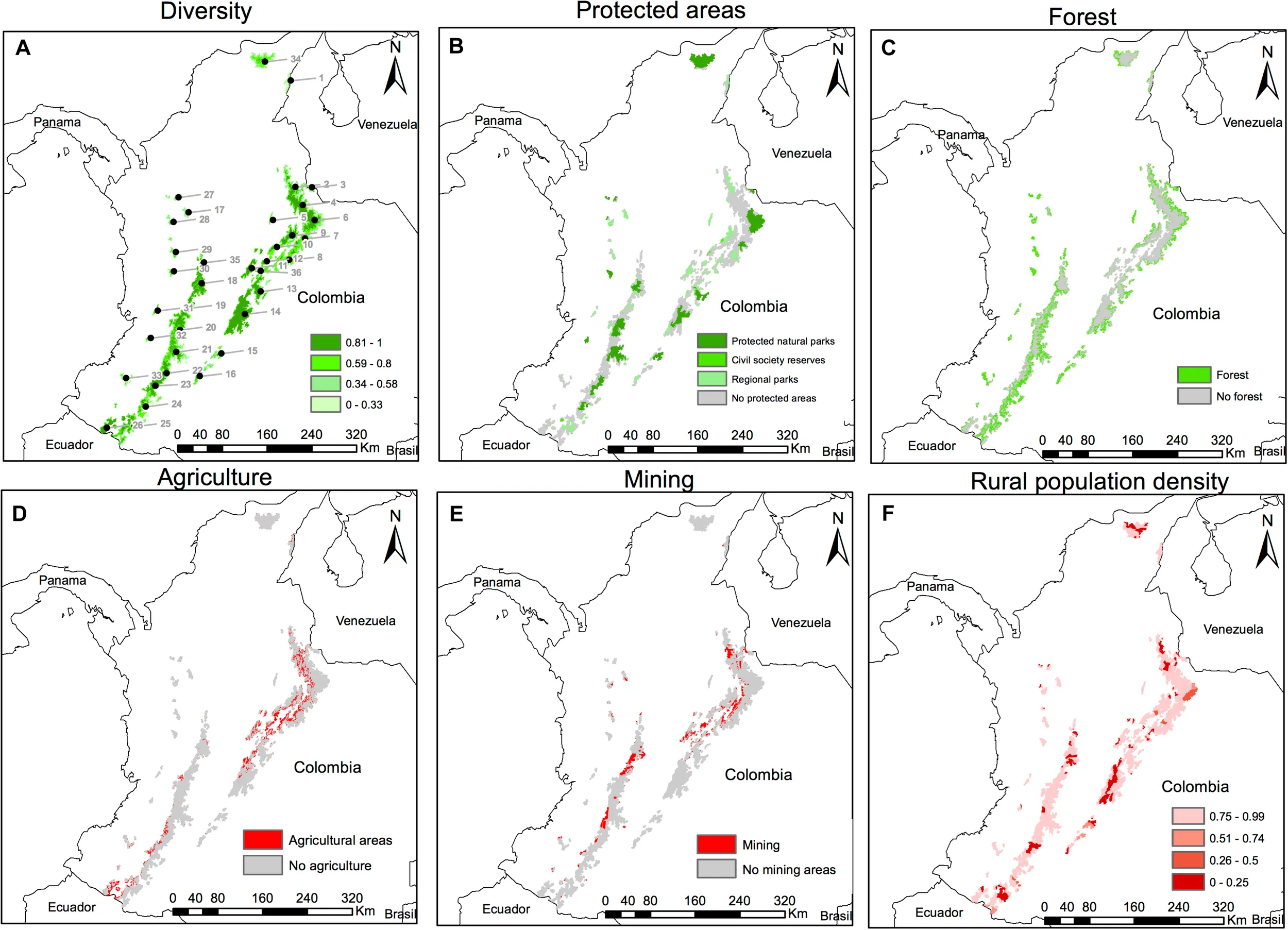
Fig. Espeletia distribution across Colombian páramo complexes
Páramos sit above the Andean treeline and feed water to millions of people downstream. They are also home to Espeletia, a genus that radiated into dozens of species unusually fast, which makes it a sensitive early indicator of climate stress. I modelled 28 taxa across 36 páramo complexes, pairing each complex's climate sensitivity with its capacity to adapt under RCP 8.5 to a 2050 horizon. The species-rich eastern complexes came out most exposed.
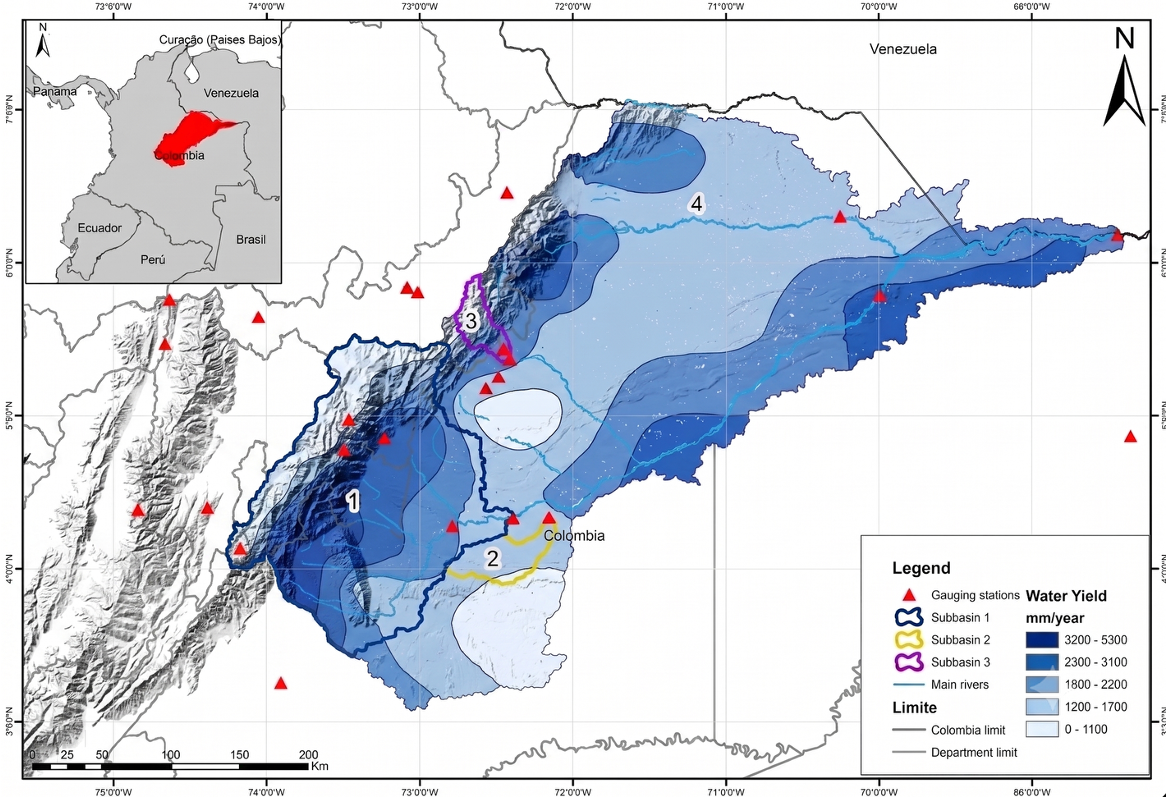
Fig. Modelled annual water yield (mm/year), Meta River basin and subbasins, Colombia
The Meta drains a wide stretch of Colombia's eastern plains, and it made a fair test of whether a global ecosystem-service tool holds up on a tropical basin it was never tuned for. I ran the InVEST annual water yield model across the basin and its subbasins, checked the output against gauging-station records, then pushed it forward under a future climate scenario. Modelled yield spanned roughly 0 to 5,300 mm per year, highest along the Andean headwaters in the west and easing off across the plains to the east.
Six peer-reviewed papers, more than 200 citations. The methodologies I apply are grounded in peer-reviewed frameworks, ensuring your team relies on scientifically defensible approaches.
A few of the notebooks I keep public. They cover the everyday building blocks of spatial and climate analysis, and the client work is documented to the same standard.
A Colab walkthrough for pulling, processing, and exporting satellite data through the Earth Engine Python API.
Open notebookThree methods for correcting CHIRPS satellite rainfall against gauge data, compared side by side, so the rainfall series is sound before anything gets built on it.
Open notebookA side-by-side comparison of deterministic (IDW) and geostatistical (Kriging) interpolation for turning sparse point measurements into continuous surfaces.
Open notebookA comparison of global forest and land-cover products that shows how the choice of source changes the answer for a given region.
Working with gridded NOAA climate reanalysis in Python: reading the fields, cutting them to a region, and pulling out the series you actually need.
Open notebookA CA-Markov model that projects future land use in Caquetá, Colombia, from historical transition rates and a cellular-automata simulation.
Open notebook
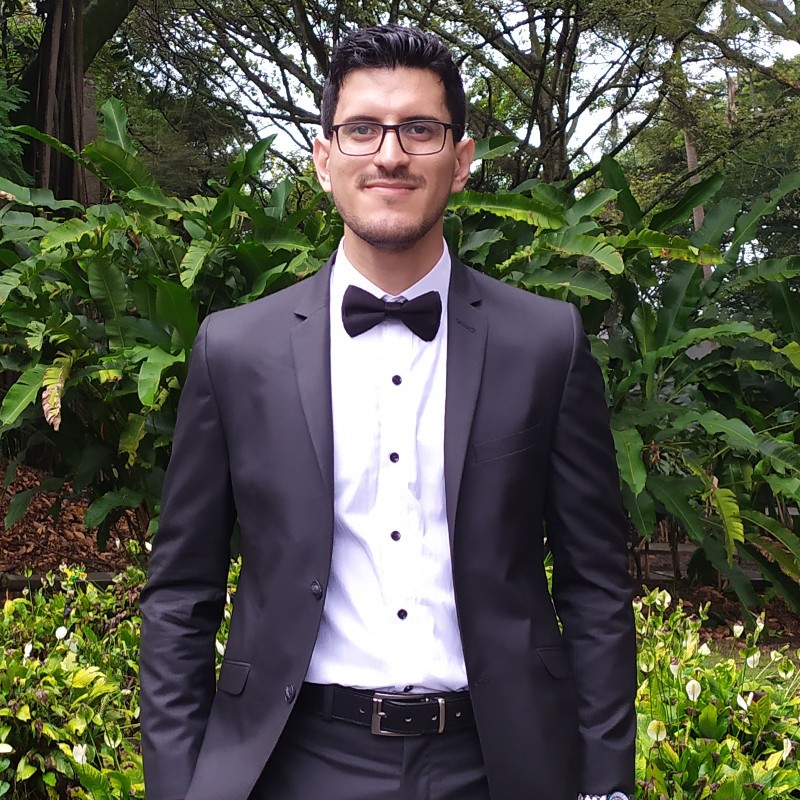
BRIAN VALENCIA GARCÍA
I am a Colombian agricultural engineer. The question that has driven my whole career is a simple one: how do we help farmers and ecosystems adapt to a changing climate? Answering it took me from fieldwork to a Master's in hydrometeorology at Kazan Federal University in Russia, and then into geospatial machine learning.
Over twelve years I have worked across the páramos of the Andes, the farming systems of sub-Saharan Africa, and precision agriculture in Australia. I spent three and a half years at CIAT on climate risk assessment, collaborated with Curtin University, and since 2023 I have been with the African Plant Nutrition Institute, where I build spatial frameworks for nutrient stewardship and climate resilience. Alongside that I am completing a PhD at the University of Twente (ITC).
I care about reproducibility and outputs people can actually use. Everything I deliver comes with the code, the documentation, and clear methods, so your team can update or extend it later. If a project is a good fit, I will say so plainly, and if it is not, I will tell you that too.
The first step is just a call. If it looks like a fit, I write up what I would do and what it would cost, and you take it from there.
A brief call to review your technical objectives, available spatial datasets, and whether the project aligns with my geospatial expertise.
If we go ahead, I send a short proposal with the deliverables and a timeline. Some projects are a two-week analysis. Others are multi-month pipelines or an interactive tool. It depends on the data.
Final deliverables include the spatial models, production-ready maps, a comprehensive report, and fully documented source code. Built entirely in R and Quarto, the pipeline allows your team to execute updates independently as new datasets become available.
Tell me what you are trying to do and what data you already have, and I will come back quickly with a rough approach and what it would take.